Author : Sairaj Kandekar from Maharashtra National Law University, Chh. Sambhajinagar is a student of B.B.A- LL.B. (Hons.), 3rd Year
1. Introduction
Social media has become one of the most influential platforms for communication and expression in modern society. Platforms such as Instagram, X (formerly Twitter), Facebook, and YouTube allow individuals to express opinions, share information, and participate in public discussions instantly. In a democratic country like India, freedom of speech and expression plays a crucial role in ensuring political awareness and public participation. However, the increasing misuse of social media through fake news, hate speech, online trolling, and misinformation has created serious legal and constitutional concerns.
The rapid spread of harmful content on digital platforms often affects public order, individual dignity, and national security. Therefore, there is a growing need to balance the constitutional right to free speech with reasonable legal restrictions. The Indian legal system has attempted to regulate online content while protecting constitutional freedoms guaranteed under the Constitution of India.
2. Constitutional Framework of Freedom of Speech
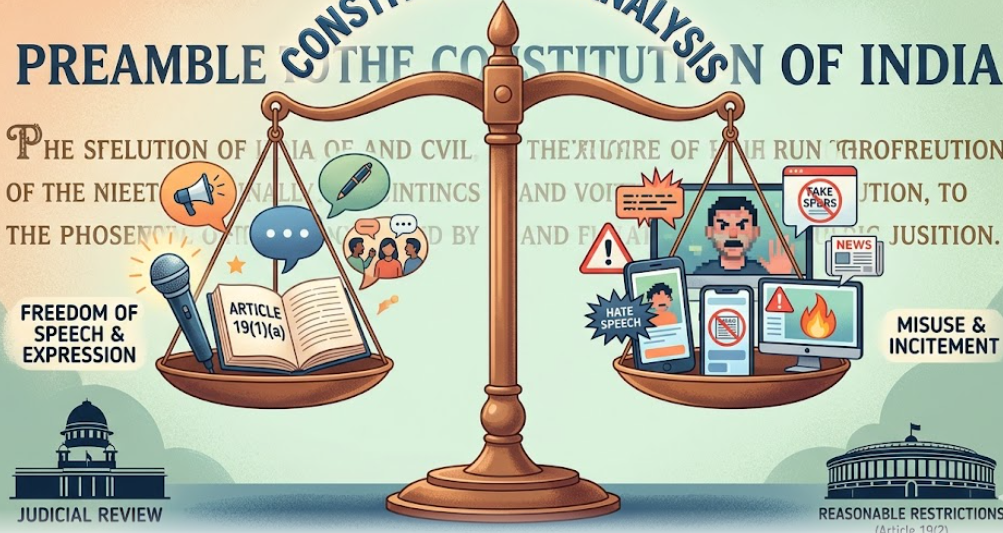
The Constitution of India guarantees freedom of speech and expression under Article 19(1)(a). This provision allows citizens to express their opinions freely through speech, writing, electronic communication, and other forms of expression. Freedom of speech is considered essential for democracy because it promotes discussion, criticism, and exchange of ideas.
However, this right is not absolute. Article 19(2) permits the State to impose reasonable restrictions in the interests of sovereignty and integrity of India, public order, decency, morality, defamation, and security of the State. Therefore, while citizens have the right to express themselves online, such freedom cannot be misused to spread hatred, violence, or misinformation.
Further, Article 21 of the Constitution protects the right to life and personal liberty, which also includes the right to privacy and dignity. Misuse of social media often violates individual privacy through online harassment, cyberbullying, and unauthorized sharing of personal information. Thus, constitutional protections must be balanced carefully in the digital age.
3. Misuse of Social Media in India
The misuse of social media has become a major challenge in India. Fake news and misleading information spread rapidly across digital platforms and often create panic and communal tensions. Social media is also frequently used for online trolling, cyber harassment, hate speech, and defamation. Such misuse negatively affects public order and individual dignity.
One of the major concerns is the spread of communal and politically motivated misinformation. False information circulated through social media has sometimes resulted in violence and public unrest. In addition, many individuals, especially women and children, become victims of cyberbullying and online abuse. Anonymous accounts and lack of accountability make regulation difficult.
Another important issue is the misuse of personal data by digital platforms. Users often share personal information online without understanding the risks involved. This raises concerns regarding privacy and data protection. Therefore, regulation of social media has become necessary to ensure responsible use while preserving democratic freedoms.
4. Legal Framework and Judicial Approach
The Information Technology Act, 2000 is the primary legislation governing online activities in India. Section 69A of the Act empowers the Government to block online content in the interest of sovereignty, public order, and national security. The Government has also introduced the Information Technology (Intermediary Guidelines and Digital Media Ethics Code) Rules, 2021, which impose obligations upon social media intermediaries to remove unlawful content and establish grievance redressal mechanisms.
Further, the Digital Personal Data Protection Act, 2023 was enacted to protect personal data and strengthen privacy rights in the digital environment. The legislation aims to ensure responsible handling of personal information by digital platforms and organizations.
The judiciary has played an important role in protecting constitutional freedoms in the digital era. In Shreya Singhal v. Union of India,1 the Supreme Court struck down Section 66A of the Information Technology Act, 2000 on the ground that it violated Article 19(1)(a) of the Constitution. The Court held that vague restrictions on online speech could lead to arbitrary censorship.
In AnuradhaBhasin v. Union of India, 2the Supreme Court recognized that access to the internet is closely connected with freedom of speech and expression under Article 19(1)(a). The Court emphasized that restrictions on internet access must satisfy the test of proportionality.
Similarly, in Kaushal Kishor v. State of Uttar Pradesh,3 the Supreme Court observed that restrictions on freedom of speech must remain within the scope of Article 19(2). The judgment highlighted the importance of constitutional balance between free speech and reasonable restrictions.
5. Challenges and Suggestions
Despite the existence of legal provisions, regulating social media remains a difficult task. One of the major challenges is balancing free speech with governmental control. Excessive regulation may result in censorship and suppression of dissenting opinions. At the same time, weak regulation can allow the spread of harmful and misleading content.
Another challenge is the lack of digital literacy among users. Many individuals unknowingly share false information without verifying its authenticity. Additionally, anonymous online platforms make it difficult to identify offenders involved in cyber harassment and hate speech.
To address these issues, the Government should promote digital awareness and strengthen cybersecurity mechanisms. Social media platforms must also act responsibly by ensuring faster removal of unlawful content. Clear legal standards and transparent regulatory mechanisms are necessary to prevent arbitrary censorship while protecting constitutional freedoms.
6. Conclusion
Freedom of speech and expression is one of the most important constitutional rights in a democratic society. Social media has strengthened public participation by providing individuals with a platform to express their opinions freely. However, the growing misuse of digital platforms through fake news, hate speech, and online harassment has created serious legal concerns.
Therefore, a balance must be maintained between individual liberty and reasonable regulation. While the State has the authority to regulate harmful online content, such restrictions must remain constitutional, proportionate, and consistent with democratic values. Responsible use of social media, combined with effective legal safeguards, is essential for protecting both freedom of expression and public interest.
REFERENCE CASE:
Very nice, This article is very well written. Social media is being heavily misused, and formulating effective legislation to address this is a challenging task.
Definitely
very good information 👌👌